Buy financejob.eu ?
We are moving the project
financejob.eu .
Are you interested in purchasing the domain
financejob.eu ?
domain@kv-gmbh.de · 0541-91531010
Buy financejob.eu ?
Do teachers unfairly favoritism?
While some teachers may show favoritism towards certain students, it is not fair to generalize and say that all teachers do so. Favoritism can be influenced by various factors such as a student's behavior, academic performance, or personal connection with the teacher. It is important for teachers to remain impartial and treat all students equally to create a fair learning environment. Communication and feedback from students can help address any concerns of favoritism in the classroom. **
What happens when parents show favoritism between their children?
When parents show favoritism between their children, it can lead to feelings of resentment, jealousy, and low self-esteem among the children who are not favored. This can create tension and conflict within the family dynamic, impacting the relationships between siblings and between the children and their parents. Additionally, the favored child may develop a sense of entitlement or lack of empathy towards their siblings, which can have long-term effects on their relationships and behavior. Overall, parental favoritism can have damaging consequences on the emotional well-being and development of all the children involved. **

Similar search terms for Favoritism
Top-Angebote
Products related to Favoritism:
-
F1 Manager 2023 (PS4), Used - GoodTake control of your Formula 1 empire with F1 Manager 2023 for PlayStation 4 , the official management simulation that puts you in the hot seat as team principal. Strategise every aspect of your team — from race-day tactics to car development, driver line-ups to sponsor deals — and lead your squad to championship glory. Whether you’re a motorsport enthusiast or a tactical thinker, this game delivers an authentic management experience with depth and polish. ✔️ Official Formula 1 Licence – All teams, drivers, circuits, and sponsors from the 2023 F1 season ✔️ Deep Strategic Gameplay – Make crucial decisions on pit stops, tyre strategy, and race tactics ✔️ Team Development & Research – Invest in upgrades to improve car performance and competitiveness ✔️ Dynamic Race Days – Real-time races where your calls influence results and standings ✔️ Driver & Staff Management – Balance morale, skills, and contracts to build the ultimate team ✔️ Multiple Game Modes – Career mode, single races, and seasonal campaigns ✔️ Immersive Presentation – Broadcast-style visuals, race commentary, and detailed telemetry ✔️ PS4 Platform Optimised – Tailored controls, menus, and performance for PlayStation 4 Whether you’re navigating the complexities of team leadership or chasing strategic mastery, F1 Manager 2023 (PS4) delivers an engaging and rewarding management simulation set in the high-stakes world of Formula 1 racing.24,99 £*Shipping: 0,00 £Secure redirect to the provider
-
Bronzhaus Bronze Sculpture Statue Abstract Bull Horns Figurine Stock Broker Sale Gift DecorCondition: This sculpture is in perfect condition Bronze Dimensions: Height 5.5 inches X Width 11 inches Weight:8 LBS Inventory:84AL0415748 Original or Reproduction: Original Transport yourself to the vibrant world of a Spanish bullfight with this…329,99 $*Shipping: 0,00 $Secure redirect to the provider
-
StarTech CABLMANAGERH 1U Rack-Mountable Rack Cable Manager - BlackCondition This product has been fully tested and verified as functional with no hardware or software defects. Any data previously held on the device has been sanitised or the storage media removed, in line with data protection standards. The item may show minor cosmetic wear, including light scratches or blemishes, though these do not affect the product’s performance or usability. The device is loaded with legally licensed software, where applicable, and is configured for full operation. I44,99 £*Shipping: 0,00 £Secure redirect to the provider
-
Scholastic True Books A True Book: The Earth at Risk Value PackThere are five major biomes on Earth: desert, forest, grassland, aquatic, and tundra. These rich, wild places are home to a wide variety of plants and animals - many of which are found nowhere else. Unfortunately, these ecosystems have been put at...32,99 $*Shipping: 0,00 $Secure redirect to the provider




-
What happens if a teacher shows favoritism towards another student?
Showing favoritism towards a student can have negative consequences for both the favored student and the rest of the class. It can create a sense of unfairness and resentment among the other students, leading to a negative classroom environment. The favored student may also develop a sense of entitlement and may not learn to work hard for their achievements. Additionally, it can damage the teacher's credibility and trust among the students and their parents. It is important for teachers to treat all students with fairness and respect in order to create a positive and inclusive learning environment. **
-
Is there often favoritism in the evaluation of bachelor's and master's theses?
Favoritism in the evaluation of bachelor's and master's theses can occur, but it is not necessarily common. The evaluation process is typically designed to be fair and impartial, with specific criteria and standards for assessment. However, the potential for favoritism exists, especially if personal relationships or biases come into play. To mitigate this, many academic institutions have established procedures for blind or double-blind evaluations, where the identity of the student is concealed from the evaluator. Additionally, having multiple evaluators and clear evaluation criteria can help ensure fairness in the assessment process. **
-
How can the favoritism towards girls in physical education classes be avoided?
To avoid favoritism towards girls in physical education classes, teachers should ensure equal opportunities for all students to participate and excel in various activities. This can be achieved by creating a supportive and inclusive environment where students feel encouraged to try new activities and improve their skills. Teachers should also provide constructive feedback and praise based on effort and progress rather than gender. Additionally, incorporating a variety of activities that cater to different interests and abilities can help prevent favoritism towards any specific group of students. **
-
What is the difference between an auditor and a business consultant?
An auditor is responsible for examining and evaluating a company's financial records and statements to ensure accuracy and compliance with regulations. They focus on identifying errors, fraud, and inefficiencies in financial processes. On the other hand, a business consultant provides strategic advice and guidance to help businesses improve their performance, operations, and overall efficiency. They may offer expertise in areas such as management, marketing, operations, and organizational structure, with the goal of helping the business achieve its objectives and overcome challenges. While auditors focus on financial compliance and accuracy, business consultants focus on overall business improvement and strategy. **


How can one become self-employed as a financial manager consultant?
To become self-employed as a financial manager consultant, one should first acquire the necessary education and experience in finance and management. This may include obtaining a bachelor's degree in finance or a related field, as well as gaining several years of experience working in financial management. Additionally, obtaining relevant certifications such as the Certified Management Accountant (CMA) or Chartered Financial Analyst (CFA) can help establish credibility. Once the necessary qualifications are obtained, one can start building a client base by networking, marketing their services, and showcasing their expertise through speaking engagements or writing articles. Finally, it's important to establish a solid business plan and set up the necessary infrastructure to operate as a self-employed financial manager consultant. **
What education is required in the investment sector to work as a financial advisor?
To work as a financial advisor in the investment sector, a minimum of a bachelor's degree in finance, economics, business, or a related field is typically required. Many financial advisors also pursue additional certifications such as the Certified Financial Planner (CFP) designation, which involves passing an exam and meeting experience requirements. Continuing education is essential in this field to stay updated on market trends, regulations, and investment strategies. Strong analytical skills, knowledge of financial products, and the ability to communicate effectively with clients are also important qualities for success in this role. **
Top-Angebote
Products related to Favoritism:
-
NordPass Premium Password ManagerNordPass is a secure and intuitive password manager that offers several features and strengths, including: Password management: NordPass allows users to securely store, manage and protect all their passwords. The master password is the only password the user has to remember, and all other passwords are encrypted and stored in an encrypted vault. Security: NordPass uses XChaCha20 encryption, one of the most advanced encryption algorithms on the market, to protect stored data. The company also adopts a no-log policy, which means that it does not collect user data or store it. NordPass also offers multi-factor authentication to add further protection to the vault. Usability: NordPass is available as a browser extension and as a mobile application, allowing users to manage passwords and logins on different devices. The interface is intuitive and easy to use, and data is encrypted using the 256-bit AES standard. Additional features: NordPass offers several additional options for managing and protecting passwords, such as storing and synchronising secure credit cards and notes, generating secure passwords and detecting weak or already used passwords In summary, NordPass is a secure and intuitive password manager that offers various features and strengths, making it an ideal choice for anyone looking to manage their passwords in a secure and convenient manner.25,90 £*Shipping: 0,00 £Secure redirect to the provider
-
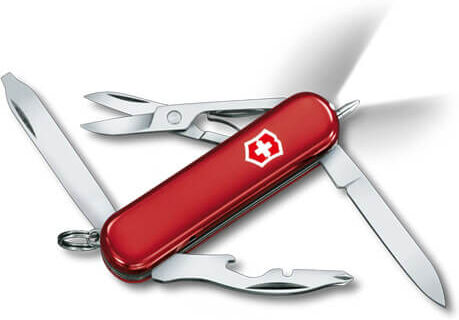
Victorinox Swiss Army Knife Midnite ManagerEffective leaders ensure that nothing obstructs their team's path to success. When challenges emerge, address them with the Victorinox Swiss Army Knife Midnite Manager pocket knife. Equipped with 10 versatile functions, including a bright LED light, this tool is always ready to assist. No matter where your journey takes you, the Manager has your back, helping you stay well-prepared and ready to lead. Tools: Blade, small / Bottle opener / Keyring / LED light / Nail file / Phillips screwdriver 0/1 (magnetic) / Pressurised ballpoint pen / Scissors / Screwdriver 2.5mm / Wire Stripper Dimensions: 1.4(H) x 5.8(L) x 2(W) cm. Weight: 0.031kg. The Victorinox Swiss Army Knife Midnite Manager is covered by a Victorinox lifetime warranty. Knives are not for sale to persons under the age of 18. - all knives and bladed products are delivered by Age Verified Delivery (AVD). The carrier may request proof of age in order to deliver your parcel. If proof of age is not available, or the recipient is underage, the carrier will refuse to deliver.52,95 £*Shipping: 0,00 £Secure redirect to the provider
-
F1 Manager 2023 (PS4), Used - GoodTake control of your Formula 1 empire with F1 Manager 2023 for PlayStation 4 , the official management simulation that puts you in the hot seat as team principal. Strategise every aspect of your team — from race-day tactics to car development, driver line-ups to sponsor deals — and lead your squad to championship glory. Whether you’re a motorsport enthusiast or a tactical thinker, this game delivers an authentic management experience with depth and polish. ✔️ Official Formula 1 Licence – All teams, drivers, circuits, and sponsors from the 2023 F1 season ✔️ Deep Strategic Gameplay – Make crucial decisions on pit stops, tyre strategy, and race tactics ✔️ Team Development & Research – Invest in upgrades to improve car performance and competitiveness ✔️ Dynamic Race Days – Real-time races where your calls influence results and standings ✔️ Driver & Staff Management – Balance morale, skills, and contracts to build the ultimate team ✔️ Multiple Game Modes – Career mode, single races, and seasonal campaigns ✔️ Immersive Presentation – Broadcast-style visuals, race commentary, and detailed telemetry ✔️ PS4 Platform Optimised – Tailored controls, menus, and performance for PlayStation 4 Whether you’re navigating the complexities of team leadership or chasing strategic mastery, F1 Manager 2023 (PS4) delivers an engaging and rewarding management simulation set in the high-stakes world of Formula 1 racing.24,99 £*Shipping: 0,00 £Secure redirect to the provider
-
Bronzhaus Bronze Sculpture Statue Abstract Bull Horns Figurine Stock Broker Sale Gift DecorCondition: This sculpture is in perfect condition Bronze Dimensions: Height 5.5 inches X Width 11 inches Weight:8 LBS Inventory:84AL0415748 Original or Reproduction: Original Transport yourself to the vibrant world of a Spanish bullfight with this…329,99 $*Shipping: 0,00 $Secure redirect to the provider
-
Do teachers unfairly favoritism?
While some teachers may show favoritism towards certain students, it is not fair to generalize and say that all teachers do so. Favoritism can be influenced by various factors such as a student's behavior, academic performance, or personal connection with the teacher. It is important for teachers to remain impartial and treat all students equally to create a fair learning environment. Communication and feedback from students can help address any concerns of favoritism in the classroom. **
-
What happens when parents show favoritism between their children?
When parents show favoritism between their children, it can lead to feelings of resentment, jealousy, and low self-esteem among the children who are not favored. This can create tension and conflict within the family dynamic, impacting the relationships between siblings and between the children and their parents. Additionally, the favored child may develop a sense of entitlement or lack of empathy towards their siblings, which can have long-term effects on their relationships and behavior. Overall, parental favoritism can have damaging consequences on the emotional well-being and development of all the children involved. **
-
What happens if a teacher shows favoritism towards another student?
Showing favoritism towards a student can have negative consequences for both the favored student and the rest of the class. It can create a sense of unfairness and resentment among the other students, leading to a negative classroom environment. The favored student may also develop a sense of entitlement and may not learn to work hard for their achievements. Additionally, it can damage the teacher's credibility and trust among the students and their parents. It is important for teachers to treat all students with fairness and respect in order to create a positive and inclusive learning environment. **
-
Is there often favoritism in the evaluation of bachelor's and master's theses?
Favoritism in the evaluation of bachelor's and master's theses can occur, but it is not necessarily common. The evaluation process is typically designed to be fair and impartial, with specific criteria and standards for assessment. However, the potential for favoritism exists, especially if personal relationships or biases come into play. To mitigate this, many academic institutions have established procedures for blind or double-blind evaluations, where the identity of the student is concealed from the evaluator. Additionally, having multiple evaluators and clear evaluation criteria can help ensure fairness in the assessment process. **
Similar search terms for Favoritism
-
StarTech CABLMANAGERH 1U Rack-Mountable Rack Cable Manager - BlackCondition This product has been fully tested and verified as functional with no hardware or software defects. Any data previously held on the device has been sanitised or the storage media removed, in line with data protection standards. The item may show minor cosmetic wear, including light scratches or blemishes, though these do not affect the product’s performance or usability. The device is loaded with legally licensed software, where applicable, and is configured for full operation. I44,99 £*Shipping: 0,00 £Secure redirect to the provider
-
Scholastic True Books A True Book: The Earth at Risk Value PackThere are five major biomes on Earth: desert, forest, grassland, aquatic, and tundra. These rich, wild places are home to a wide variety of plants and animals - many of which are found nowhere else. Unfortunately, these ecosystems have been put at...32,99 $*Shipping: 0,00 $Secure redirect to the provider
-
Arrow John Grisham Collection 8 Books Set (Series 2) (Bleachers, Skipping Christmas, Broker, Painted House amd More)John Grisham Collection 8 Books Set Series 2 The Broker In his final hours in the Oval Office, the outgoing president grants a controversial last-minute pardon to Joel Backman, a notorious Washington power broker who has spent the last six years hidden away in a federal prison. What no one knows is that the president issues the pardon only after receiving enormous pressure from the CIA. It seems Backman, in his power-broker heyday, may have obtained secrets that compromise the world's most sophisticated satellite surveillance system. A Painted House The hill people and the Mexicans arrived on the same day. It was a Wednesday, early in September, 1952. The Cardinals were five games behind the Dodgers with three weeks to go, and the season looked hopeless. The cotton, however, was waist-high to my father, over my head, and he and my grandfather could be heard before supper whispering words that were seldom heard. It could be a "good crop". Ford County In his first collection of short stories John Grisham takes us back to Ford County, Mississippi, the setting of his first novel, A Time To Kill. Wheelchair-bound Inez Graney and her two older sons, Leon and Butch, take a bizarre road trip through the Mississippi Delta to visit the youngest Graney brother, Raymond, who's been locked away on death row for 11 years. It could well be their last visit. Bleachers Neely Crenshaw was once star quarterback for Messina High School's football team. His playing days ended with a sickening injury. Afterwards his life went nowhere: his marriage foundered and his real estate business drifted. For fifteen years he's been trying to forget his glorious past as sporting hero but hasn't been able to move on. But now the man who moulded him, Coach Eddie Rake, is dying and Neely returns to Messina. Rake has acted as football coach for 34 years at Messina High; his teams have won 13 state championships and been on an 84 game unbeaten streak. Skipping Christmas Imagine a year without Christmas. No crowded shops, no corny office parties, no fruitcakes, no unwanted presents. That's just what Luther and Nora Krank have in mind when they decide that, just this once, they'll skip the holiday altogether. Theirs will be the only house on the street without a rooftop Frosty the Snowman; they won't be hosting their annual Christmas Eve bash; they aren't even going to have a tree. Playing for Pizza Rick Dockery was the third-string quarterback for the Cleveland Browns. In the deciding game at the climax of the season, to the surprise and dismay of virtually everyone, Rick actually got into the game. With a 17-point lead and just minutes to go, Rick provided what was arguably the worst single performance in the history of the National Football League. Overnight, he became a national laughing stock and, of course, was immediately dropped by the Browns and shunned by all other teams. The King of Torts The Office of the Public Defender is not known as a training ground for bright young...21,95 £*Shipping: 2,99 £Secure redirect to the provider
-
How can the favoritism towards girls in physical education classes be avoided?
To avoid favoritism towards girls in physical education classes, teachers should ensure equal opportunities for all students to participate and excel in various activities. This can be achieved by creating a supportive and inclusive environment where students feel encouraged to try new activities and improve their skills. Teachers should also provide constructive feedback and praise based on effort and progress rather than gender. Additionally, incorporating a variety of activities that cater to different interests and abilities can help prevent favoritism towards any specific group of students. **
-
What is the difference between an auditor and a business consultant?
An auditor is responsible for examining and evaluating a company's financial records and statements to ensure accuracy and compliance with regulations. They focus on identifying errors, fraud, and inefficiencies in financial processes. On the other hand, a business consultant provides strategic advice and guidance to help businesses improve their performance, operations, and overall efficiency. They may offer expertise in areas such as management, marketing, operations, and organizational structure, with the goal of helping the business achieve its objectives and overcome challenges. While auditors focus on financial compliance and accuracy, business consultants focus on overall business improvement and strategy. **
-
How can one become self-employed as a financial manager consultant?
To become self-employed as a financial manager consultant, one should first acquire the necessary education and experience in finance and management. This may include obtaining a bachelor's degree in finance or a related field, as well as gaining several years of experience working in financial management. Additionally, obtaining relevant certifications such as the Certified Management Accountant (CMA) or Chartered Financial Analyst (CFA) can help establish credibility. Once the necessary qualifications are obtained, one can start building a client base by networking, marketing their services, and showcasing their expertise through speaking engagements or writing articles. Finally, it's important to establish a solid business plan and set up the necessary infrastructure to operate as a self-employed financial manager consultant. **
-
What education is required in the investment sector to work as a financial advisor?
To work as a financial advisor in the investment sector, a minimum of a bachelor's degree in finance, economics, business, or a related field is typically required. Many financial advisors also pursue additional certifications such as the Certified Financial Planner (CFP) designation, which involves passing an exam and meeting experience requirements. Continuing education is essential in this field to stay updated on market trends, regulations, and investment strategies. Strong analytical skills, knowledge of financial products, and the ability to communicate effectively with clients are also important qualities for success in this role. **
* All prices are inclusive of VAT and, if applicable, plus shipping costs. The offer information is based on the details provided by the respective shop and is updated through automated processes. Real-time updates do not occur, so deviations can occur in individual cases. ** Note: Parts of this content were created by AI.